Surface morphology
Secondary electrons are generated near the surface and are useful for pattern shape, edges, and surface roughness.

SEM Principles
SEM is a system where the electron gun, vacuum system, electron lenses, scan coils, detectors, and image processing electronics work together. A focused electron probe scans the sample surface, and generated signals are mapped to position information to form an image.
The electron gun creates a stable emission current, while acceleration voltage determines the electron energy reaching the sample.
Condenser and objective lenses reduce the beam into a small probe, while scan coils move it sequentially across the sample surface.
Signal intensity detected at each X-Y position becomes brightness and contrast, revealing surface morphology and composition differences.
System Components
Signals
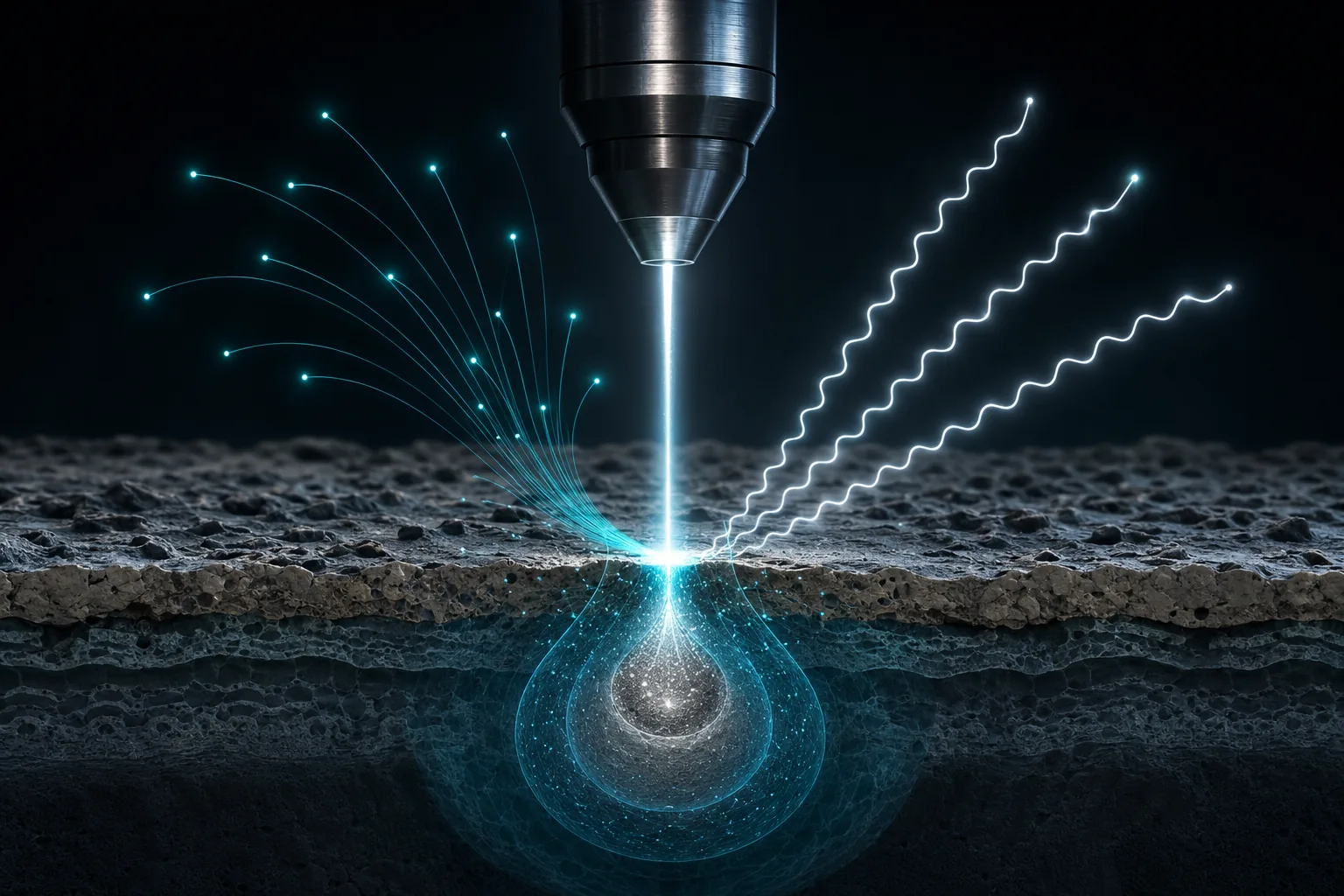
Secondary electrons are generated near the surface and are useful for pattern shape, edges, and surface roughness.
Backscattered electrons include relatively deeper information and can show contrast based on atomic number differences.
Analyzing characteristic X-rays helps identify elemental information at a defect location or selected area.
Image Formation
The electron probe scans X-Y positions on the sample surface sequentially.
ConsultElectron-sample interaction generates signals such as SE, BSE, and X-ray.
TechDetectors collect and amplify target signals, then send them to image processing.
ProductsSignal intensity at each position is converted into pixel brightness to create image contrast.
AppsResolution & Focus
Improving resolution requires a smaller probe size and high-magnification conditions, but signal amount and depth of focus can decrease. For samples with large steps or uneven surfaces, securing enough depth of focus and signal may be more important.
Therefore, SEM review should cover not only required resolution but also sample geometry, step height, observation magnification, signal type, and repeat inspection conditions.